







Tire-Rotation Guide for Drivers Who Regularly Use I-65
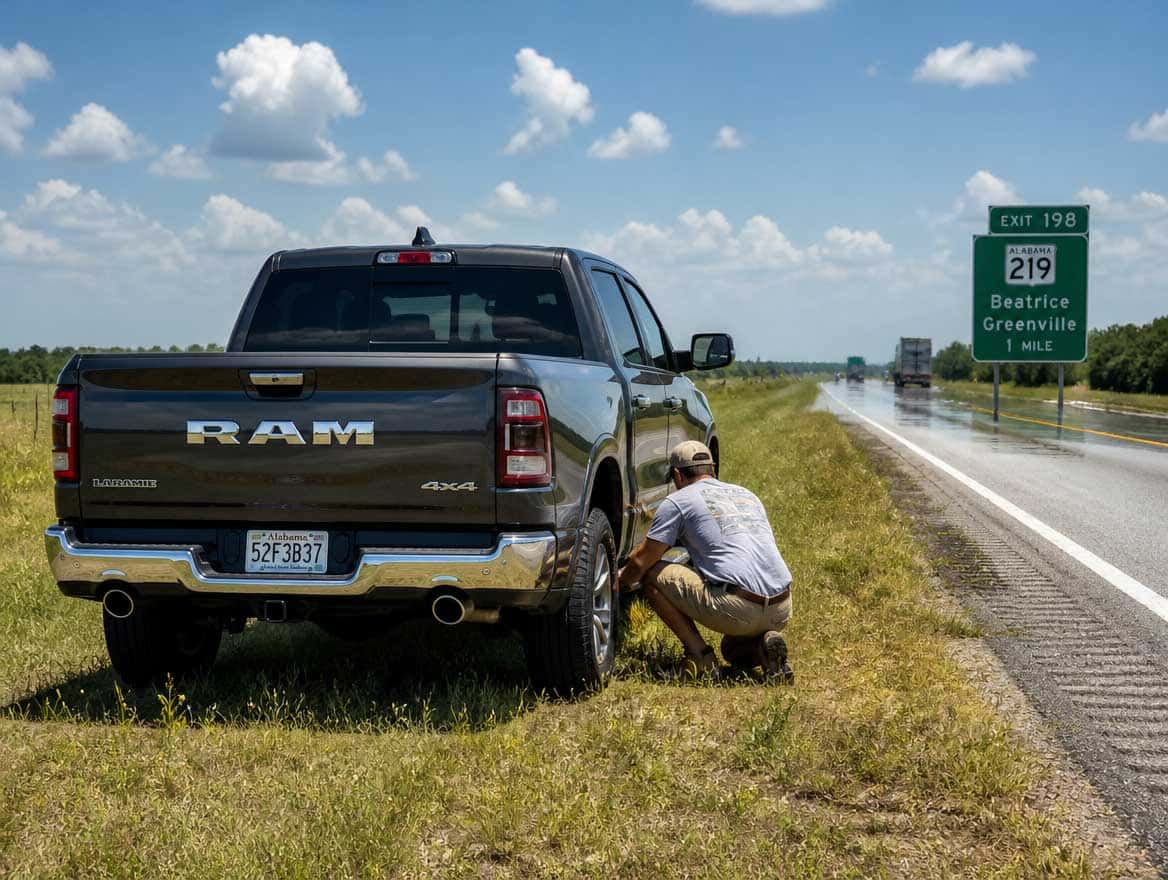
If you run I-65 between Prattville and Montgomery on a regular basis, your tires face something most generic rotation guides skip over. Sustained highway speed on Alabama asphalt can push surface temperatures to 130 to 160 degrees Fahrenheit on a summer afternoon. The load is nothing like a leisurely Sunday drive. The heat, the speed, and the specific drivetrain under your truck or SUV all change what “rotate every 5,000 miles” really means for you.
On Cobbs Ford Road, our service team watches this pattern up close. Highway miles read as gentle miles, and it’s easy to figure that stop-and-go surface roads punish brakes harder. They do. But sustained heat on hot pavement, paired with the wrong rotation pattern for your drivetrain, creates uneven wear that builds quietly until a tech spots it at your next oil change.
Schedule your next rotation at Stivers Chrysler Dodge Jeep Ram
- Ram 1500, 2500, 3500 (RWD/4WD): Rearward cross pattern; rotate every 5,000 miles if you’re towing or hauling, every 6,000-7,500 miles for standard highway commuting.
- Jeep Grand Cherokee, Grand Cherokee L, Wrangler, Gladiator (4WD/AWD): Rearward cross or X-pattern; AWD systems demand the tighter 5,000-mile end because tread depth mismatches stress the drivetrain.
- Jeep Compass, Cherokee, Chrysler Pacifica (FWD/AWD): Forward cross for FWD variants, rearward cross for AWD; every 5,000-7,500 miles per your owner’s manual.
- Dodge Durango, Jeep Grand Wagoneer (AWD): Rearward cross; stay at 5,000 miles (these rear-biased AWD systems wear the rear tires sooner than you’d expect).
- Alabama heat rule for everyone: Always check tire pressure cold (vehicle parked at least 3 hours) before the hottest months. Pressure rises roughly 1 PSI for every 10 degrees Fahrenheit, so what read correct in March isn’t necessarily correct on a July afternoon on I-65.
What Actually Matters When Choosing Your Rotation Interval?
Two variables drive the whole decision, and generic advice tends to gloss over both of them. Your drivetrain sets the pattern, and your driving surface temperature sets how tight the interval needs to be. Get those two right and everything else follows; miss them and the manual’s mileage number can steer you wrong.
| Vehicle / Drivetrain | Best Pattern | Interval | Key Spec to Know | Real Tradeoff |
|---|---|---|---|---|
| Ram 1500/2500/3500 (RWD) | Rearward Cross | 5,000-7,500 mi | Rear tires handle acceleration torque; they wear faster than fronts | Towing or heavy payload: move to 5,000 mi (load stress accelerates rear wear) |
| Jeep Wrangler / Gladiator (4WD, part-time) | Rearward Cross | 5,000-7,000 mi | In 2WD mode it drives like RWD; frequent 4WD engagement demands the shorter end | Directional tires (some Rubicon spec) can only go front-to-rear on the same side; crossing them kills wet grip |
| Jeep Grand Cherokee / Grand Cherokee L (AWD) | Rearward Cross or X-Pattern | 5,000 mi | AWD sends power to all four corners; a tread depth mismatch strains the transfer case | Must rotate all four tires together; replacing just two can stress the AWD system |
| Jeep Compass / Cherokee (FWD or AWD) | Forward Cross (FWD) / Rearward Cross (AWD) | 5,000-7,500 mi | FWD front tires handle steering, braking, and torque at once, wearing 2-3x faster than rears | Skipping rotations on FWD means replacing front tires around 30,000 miles while rears still have life |
| Chrysler Pacifica (FWD) | Forward Cross | 5,000-7,500 mi | Same FWD front-wear dynamic; a fully loaded Pacifica adds real weight that accelerates front wear | Lean toward the shorter end of the range when you’re regularly running a full passenger load |
| Dodge Durango / Jeep Grand Wagoneer (AWD) | Rearward Cross | 5,000 mi | Rear-biased AWD means the rear tires carry disproportionate torque load | Longer interval risks tread depth mismatch across axles; AWD drivetrain repair costs far outweigh rotation cost |
The rearward cross shows up so often on this list for a simple reason. Most of our lineup runs rear-wheel-drive or rear-biased AWD, and on those drivetrains the rear tires manage acceleration torque and wear faster than the fronts. Moving the less-worn fronts diagonally to the rear, and the rears straight forward, spreads the stress across all four positions. For FWD vehicles the forward cross flips that, since the fronts carry the full load of steering, acceleration, and most braking. On those, the fronts do nearly all the work.
The Alabama Heat Factor Changes Your Pressure Math
Heat does real work on your pressure numbers, and I-65 through Prattville puts your tires on Alabama asphalt that reaches surface temperatures of 130 to 160 degrees Fahrenheit under direct summer sun. Tire pressure rises roughly 1 PSI for every 10-degree Fahrenheit temperature increase, so a tire you set correctly in a cool garage at 7 a.m. can read 4 to 6 PSI higher after an hour on I-65 at midday in July. No malfunction there. It’s exactly how the physics works.
The trap is checking a hot tire and bleeding air down to hit the placard number. Once that tire cools overnight, you’re underinflated. A tire running low on pressure flexes more through every rotation, which generates more friction heat inside, and that degrades the rubber compound faster than the design intends. Check pressure cold, before the first drive of the day, and match it to the placard inside your driver’s door rather than the number molded into the tire sidewall. Those are two different figures.
Jeep Grand Cherokee owners on AWD configurations watch this pressure issue magnify at rotation time. Uneven pressure across four driven positions shows up as uneven tread depth, and that tread depth variation across axles is what stresses the transfer case over thousands of miles.
Ram 1500 drivers hauling anything between Prattville and Montgomery deal with a load-plus-heat combination that stacks wear faster than either factor alone. If you’re towing regularly, the 5,000-mile rotation interval is simply the accurate one. Ask the tech to check lug nut torque after the rotation. It takes a few extra minutes and matters.
- Check tire pressure cold, before the first drive, ahead of any I-65 miles
- Use the placard number on your driver’s door jamb rather than the sidewall figure
- Look for center-stripe wear (overinflation pattern) or shoulder wear (underinflation or alignment)
- Ask the tech to note tread depth at each of the four positions every rotation
- Confirm the rotation pattern matches your drivetrain before any rotation, in-shop or at home
Match Your Rotation Schedule to How You Actually Drive I-65
The number printed in your owner’s manual assumes an average driver in average conditions, and that’s a fine starting point for most garages. Regular I-65 commuters in the Prattville-Montgomery corridor sit outside that average, so the practical interval usually lands tighter than the manual’s upper figure. I-65 passes through Prattville.
A Prattville-to-Montgomery round trip is roughly 30 to 40 miles depending on where you’re headed in the city. Five days a week puts you at 5,000 miles in about 14 to 17 weeks of weekday commuting. Call it three to four months, not the six you might picture. If you’ve been thinking of rotation as a twice-a-year thing, the math of your actual commute probably argues for something closer to every 90 days.
If you’re towing week in and week out, trim the interval to 5,000 miles regardless of season. Running a Jeep Gladiator for a trade or farm operation on I-65 and county roads both? Same answer. A Chrysler Pacifica doing school pickup plus the Montgomery commute with seven aboard sits in a comparable situation. The weight changes the wear rate in a way the standard printed interval doesn’t fully account for.
Here’s the plain tradeoff with a tighter rotation schedule. You’ll book more service appointments over the life of the vehicle, and we’ll say that straight. The payoff is that with regular rotations, most all-season tires wear to replacement together near 50,000 to 60,000 miles rather than requiring you to replace two tires at around 30,000 miles while the other two still have life. The math almost always favors the tighter schedule when you’re putting genuine I-65 commuter miles on a Ram, Jeep, or Chrysler.
Book Your Tire Rotation at Stivers CDJR
Our service team on Cobbs Ford Road handles the full lineup (Ram trucks with heavy-haul needs, Jeep 4WD and AWD systems, and FWD Pacificas loaded for the school run). We’ll confirm the right pattern and cadence for what you’re actually driving.
Frequently Asked Questions
How often should I rotate my tires if I commute I-65 to Montgomery daily?
If you’re making the Prattville-to-Montgomery run on weekdays, the 5,000-mile rotation interval is the practical choice. A round trip covers roughly 30 to 40 miles depending on your Montgomery destination, which puts you at 5,000 miles in around 14 to 17 weeks of weekday driving. Alabama’s summer asphalt heat on I-65 can accelerate the wear that a longer interval would let develop unchecked. Your owner’s manual gives the upper boundary; your actual route and load set the practical schedule.
Does the rotation pattern really matter, or is any rotation better than none?
Pattern matters as much as the rotation itself. Crossing directional tires (look for an arrow or “rotation” marking on the sidewall) to the opposite side reverses their designed rotation direction and reduces wet-weather grip (exactly the condition you need it on an Alabama storm day on I-65). For Ram trucks and Jeep 4WD/AWD vehicles, the rearward cross correctly moves the less-worn fronts to the rear positions that need the help. For FWD vehicles like the Chrysler Pacifica and Jeep Compass, the forward cross does the reverse. Any rotation is better than none, but the correct pattern for your drivetrain gets you significantly more out of the service.

0 comment(s) so far on Tire-Rotation Guide for Drivers Who Regularly Use I-65