







Ram 1500 vs Ram 2500 for Fall Yard Projects
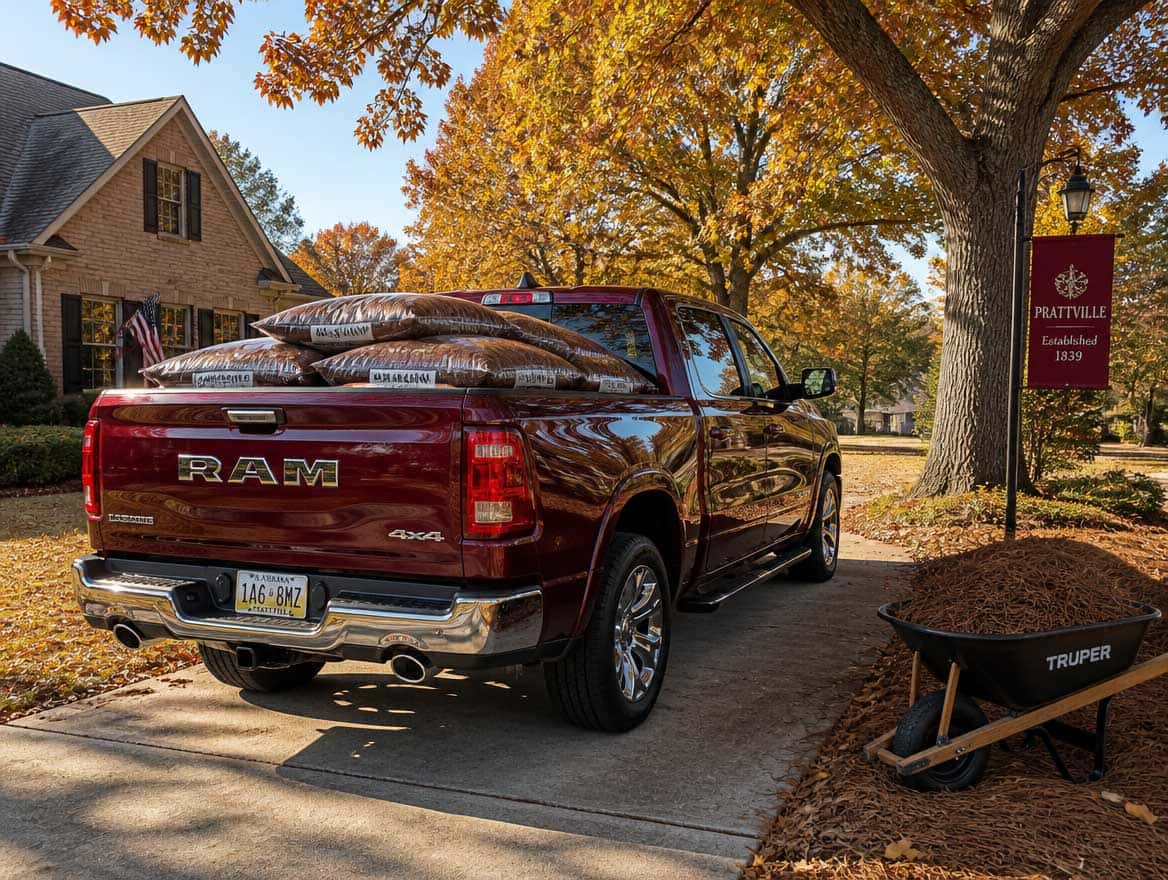
For most Prattville fall yard projects, the 2026 Ram 1500 has the payload to handle the job. Pull it when the loads stay reasonable, the trailer stays light, and you plan on a second trip if you need one. But haul bulk mulch runs, tow a loaded landscape trailer, or tackle serious cleanup across a half-acre lot, and the Ram 1500 will hit its ceiling before your Saturday ends. The 2500 earns its place right there.
- The 2026 Ram 1500 carries up to 2,360 lbs of payload (properly equipped, V6 configuration) and tows up to 11,610 lbs. Plenty for most residential fall yard days.
- The 2026 Ram 2500 carries up to 3,930 lbs of payload (gas engine) and tows up to 20,000 lbs when properly equipped. Built for bulk material hauling and loaded landscape trailers.
- The deciding factor isn’t towing capacity. It’s how much you’re loading in a single trip, and whether your mulch is wet.
- Wet wood mulch can top 1,000 lbs per cubic yard. Three wet yards push past the 1500’s max payload. The 2500 doesn’t flinch at three yards.
What’s the Real Difference Between the 1500 and 2500 for Yard Hauling?
The difference that matters for yard hauling isn’t the number on a spec sheet so much as whether you make two trips or one, and whether your truck squats on the drive home from the landscape supply yard once the bed is full of wet material. Ram lists the 2026 Ram 1500’s maximum payload at 2,360 lbs when properly equipped with the V6 engine. The 2026 Ram 2500 tops out at 3,930 lbs with the gas 6.4L HEMI. That 1,570-lb difference works out to roughly two more cubic yards of dry wood mulch, or one yard of wet.
| Task | 2026 Ram 1500 | 2026 Ram 2500 | Edge |
|---|---|---|---|
| Max bed payload (properly equipped) | Up to 2,360 lbs (V6) | Up to 3,930 lbs (gas) | 2500 |
| Max towing capacity (properly equipped) | Up to 11,610 lbs | Up to 20,000 lbs (diesel) | 2500 |
| 1-2 yards dry wood mulch (400-800 lbs/yd) | Handles it comfortably | Well within range | 1500 fine |
| 3+ yards wet wood mulch (1,000+ lbs/yd) | At or over payload limit | Handles it | 2500 |
| Light landscape trailer (under 6,000 lbs) | Capable | Capable | 1500 fine |
| Loaded equipment trailer (12,000-17,000 lbs) | Exceeds rating | Built for it | 2500 |
| Daily driver comfort + occasional yard work | Excellent ride, coil-spring rear | Stiffer rear suspension | 1500 |
Dry wood mulch runs 400 to 800 lbs per cubic yard, but after a good Alabama rain it can top 1,000 lbs per yard. Order three yards on a wet fall day and your 1500 sits at its limit before passengers and equipment climb in. The 2500 absorbs that load without a second thought.
Does Your Fall Project Need a Trailer, or Just the Bed?
Start with the trailer question, because most fall yard work in Prattville lives entirely in the bed, and a bed-only job usually points you at a 1500, while a genuine towing need is what pushes the decision toward heavier metal. Leaf cleanup, light pine straw work, and small debris runs rarely exceed what the bed can hold, and for that kind of day a Ram 2500 is overkill. A financing conversation is worth having before you buy up to a truck you only need three times a year.
Think about it by load type. Bagged pine straw in standard square bales runs about 35 lbs each, so you’d need roughly 57 bales to load 2,000 lbs. You’d be looking at an enormous pile of bags and almost certainly a multi-trip job no matter which truck you drive. The 1500 handles that. Order bulk loose mulch delivered to your truck at a landscape supply yard, and one or two yards dry sits squarely in 1500 territory. Three yards wet does not.
Trailers change the equation entirely. If you’re towing a landscape trailer with a zero-turn mower and a full leaf collection system, you’re looking at 3,000 to 6,000 lbs, still inside the 1500’s tow rating.
Pull a small box trailer with a riding tractor, limb-cut debris, and mulch bags on top, and a 1500 with the Trailer-Tow Group is probably fine. Push into the 10,000-to-17,000 lb range (think a large enclosed trailer with multiple pieces of equipment) and the 2500’s HD frame, upgraded rear suspension, and class-leading diesel torque make a genuine difference in stability and control.
Explore Your Financing Options
Prattville’s Fall Yard Calendar and What Each Truck Handles
Central Alabama’s fall yard season stretches longer than the calendar might suggest, which matters because the truck you pick has to cover light October mulch runs and heavy November debris alike, and those two jobs ask very different things of a payload rating. Lawn care services active in the Prattville market note that mowing schedules drop to biweekly around mid-September and wind down toward late fall as dormancy sets in. The heavy-lift months land October through December, when oak and pine trees in Autauga County shed leaves and pine straw through November and keep dropping into early December. Alabama also runs a secondary severe-weather season from November into mid-December, which means storm debris. Downed branches and scattered debris piles stack up fast on top of the normal seasonal leaf load.
Break it down month by month, and the split between the two trucks gets clear.
October (peak mulch season): You’re laying pine straw in the beds, hauling leaf debris, and possibly doing a last-round mowing. One to two yards of dry mulch, a light trailer run. The 1500 covers this entirely.
November (heavy debris month): Leaves are thick, storm cleanup is possible, and bulk mulch orders get heavier if you’re doing a late-season bed refresh. Three yards wet, a loaded trailer, chainsaw debris haul. Now the 2500 starts to earn its difference.
December (final cleanup): The goal is getting the yard clean before winter. Smaller loads, but if you’re pulling a trailer with rakes, blowers, and a pile of bagged waste, the 1500 handles it fine.
For year-round use, a truck that handles yard work and the daily commute on Cobbs Ford Road into Montgomery lives in 1500 territory almost all year. The 2500 makes sense when the yard work isn’t occasional, when you’re running multiple loads per weekend, towing real weight regularly, or the truck doubles as a work vehicle the other five days.
Pros and Cons at a Glance
| Ram 1500 | Ram 2500 | |
|---|---|---|
| Pros | Comfortable daily ride, strong payload for most yard days, better highway fuel economy | Vastly higher payload ceiling, superior towing for loaded trailers, HD frame for repeat heavy use |
| Cons | Payload varies sharply by engine (as low as 1,490 lbs on HO trim), hits a wall with 3+ wet yards | Stiffer rear suspension, heavier, higher operating costs for a part-time yard truck |
So Which Ram Should You Pick?
The decision comes down to one question about how you’ll actually use the truck, whether it’s also your work truck or mostly a daily driver that pulls weekend duty in the fall, and your answer there settles the payload debate faster than any spec comparison will. Give it a straight read before you shop.
Pick the Ram 1500 if you’re a Prattville homeowner doing seasonal yard projects, a few mulch runs, a leaf trailer, a pine straw refresh, and you want a truck that commutes comfortably and doesn’t feel like a job-site vehicle on regular days. Spec it with the right payload configuration for your loads. The Pentastar V6 trim carries the most payload at up to 2,360 lbs; add the Hurricane HO for performance and you accept a lower ceiling of up to 1,490 lbs.
Pick the Ram 2500 if the fall yard work is part of a bigger pattern. You’re also hauling equipment, running heavy trailers for work, or moving bulk material more than a few times a season. The 2500’s 3,930-lb gas payload handles three yards of wet mulch without straining, and that HD frame keeps the truck composed when the load is serious.
We can walk you through both on the lot. Bring your trailer if you have one. Seeing the hitch height and receiver on both trucks tells you a lot. And if you’re not sure which direction makes sense, our team is straightforward about it. We’d rather match you to the right truck than sell you more than you need.
Browse our current Ram truck inventory
Frequently Asked Questions
Can a Ram 1500 haul mulch from a landscape supply yard?
Yes, with some conditions. The 2026 Ram 1500 carries a maximum payload of up to 2,360 lbs when properly equipped with the V6 engine and right cab configuration. One to two cubic yards of dry wood mulch (roughly 400 to 800 lbs per yard) stays well within that. The problem is wet mulch: after rain, a cubic yard of wood mulch can top 1,000 lbs. Three yards wet pushes past the 1500’s payload limit. Check your truck’s door-jamb sticker for the actual payload number. It varies by engine and configuration, and never rely on the max advertised figure for your specific build.
Is the Ram 2500 worth it for yard work if I don’t use it for heavy towing?
That depends on your frequency and load size. If yard work is a few weekends per fall season with light-to-moderate loads, the Ram 1500 is likely the more practical choice. It’s more comfortable as a daily driver and its payload handles most residential hauling. The 2026 Ram 2500 makes more sense when hauling is regular (multiple heavy loads per weekend), when loads consistently approach or exceed 2,000 lbs, or when the truck also handles real commercial work the rest of the week. The 2500’s stiffer rear suspension and higher operating costs are real trade-offs for a truck that’s only pulling light yard duty a handful of times per year.

0 comment(s) so far on Ram 1500 vs Ram 2500 for Fall Yard Projects