







Battery-Service Guide for Central Alabama Vehicle Owners
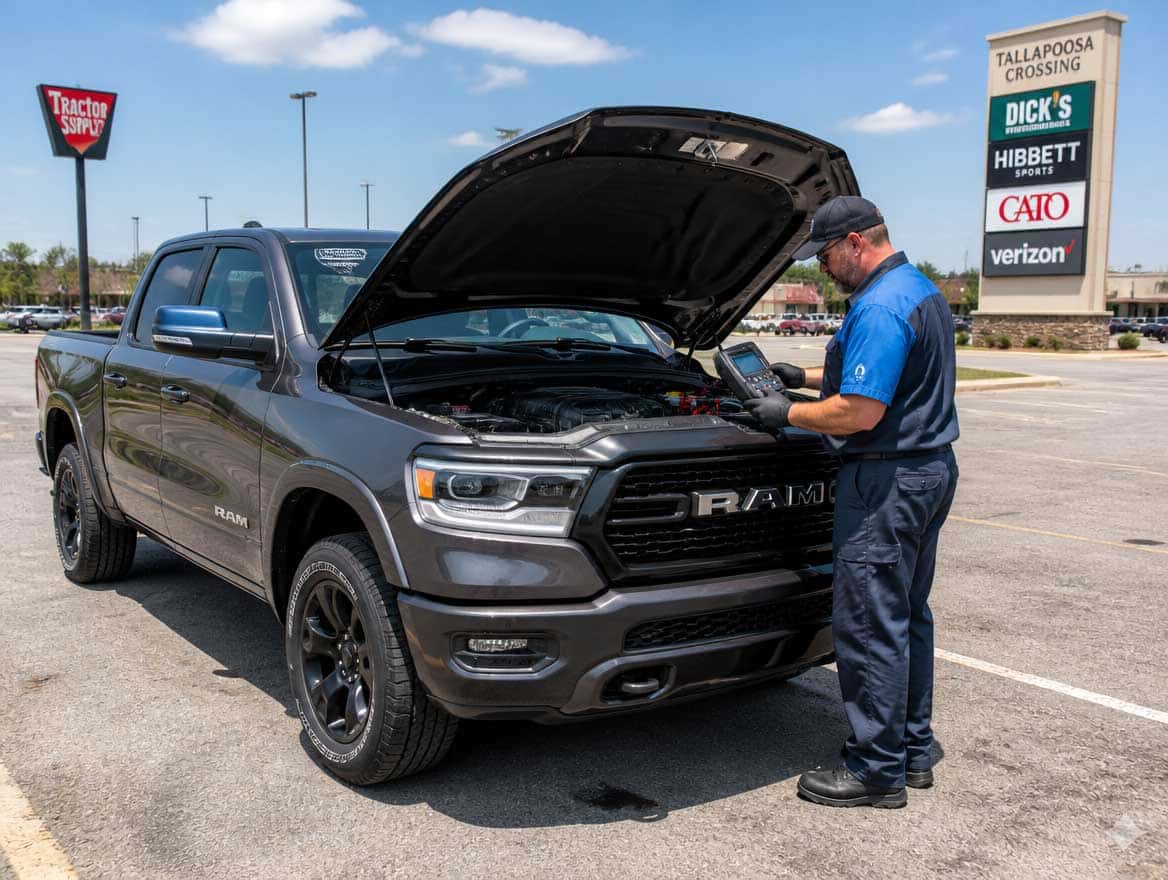
Value in a battery replacement isn’t the sticker on the shelf. It’s the number of Alabama summers that battery survives, the charging-system health it protects, and whether it matches what your specific vehicle actually needs. Get that wrong, and a cheaper battery becomes a very expensive one.
Here’s the bottom line up front. Central Alabama summers routinely push daytime highs near 95 degrees Fahrenheit, and that sustained heat is the single biggest accelerant of battery degradation. A conventional flooded battery that might last five years in Minnesota lasts two to three years here. More critically, many Ram trucks, Jeep Grand Cherokees, Dodge Durangos, and Grand Cherokee Ls come from the factory equipped with an AGM (absorbed glass mat) battery. Swap that out for a cheap conventional flooded unit and you might be looking at a failed replacement inside eighteen months, plus a charging-system warning light you didn’t expect.
That’s the conversation we have in our service bay that almost no generic battery guide ever explains.
What Do You Actually Get at Each Battery Tier?
Battery shopping trips people up because the numbers on the label look comparable while the chemistry underneath them isn’t, and that gap is exactly why Central Alabama runs on three distinct tiers, each one built for a different vehicle and a different driving pattern. Sort out which one your vehicle was engineered for, and the rest of the choice gets simple. Here’s what each tier actually delivers.
| Tier | What You Actually Get | Best Fit for This Market |
|---|---|---|
| Conventional flooded lead-acid | Liquid electrolyte, lowest upfront investment, adequate for light electrical loads; heat accelerates plate corrosion and fluid evaporation, shortening life to 2-3 years in our climate | Older or simpler vehicles with no start-stop system and modest electronics; drivers putting consistent highway miles (Cobbs Ford Rd to Montgomery and back) who recharge fully each trip |
| Enhanced flooded battery (EFB) | Improved plate design and separator materials over standard flooded; handles mild start-stop cycling better; mid-range lifespan in hot climates | Vehicles with basic start-stop that shipped with EFB from the factory; a correct like-for-like swap where the OEM spec calls for EFB |
| AGM (absorbed glass mat) | Electrolyte held in glass mats instead of free liquid; sealed design; handles repeated deep cycling, vibration from rough roads, and the heavy electronic loads of modern trucks and SUVs; longer service life in hot climates | Ram 1500s and 2500s with towing accessories and high electrical demand; Jeep Grand Cherokee L and Grand Wagoneer with start-stop systems and premium tech loads; any CDJR vehicle whose owner’s manual or VIN lookup specifies AGM |
The tradeoff is real and worth saying plainly. AGM costs more upfront. Full stop. For a basic older vehicle with no start-stop and simple electrical needs, the conventional flooded battery is genuinely the right call, so don’t spend more than you need to. But for a modern Ram truck hauling across Autauga County with a bed full of tools, or a Grand Cherokee L running three-row loads of kids and a full suite of driver-assist systems, AGM is the spec your vehicle was engineered around, and violating that spec is where the money quietly gets lost.
The Misreplacement Problem: Why Central Alabama Owners Lose Money Twice
The pattern our service team sees in AGM-equipped vehicles after an independent battery swap tends to run the same way most every time, and the part that surprises people is that it rarely points back to a defective battery at all. The new unit charges fine for a while, then the start-stop system starts cutting out, then the battery warning light shows up, and finally the battery itself fails well under two years.
Start-stop systems, which automatically shut off the engine at stoplights and restart it when you press the accelerator, cycle the battery hundreds of times more per year than conventional driving. AGM and EFB chemistry is built for that duty cycle. Install a conventional flooded battery in a start-stop vehicle and it’ll fail prematurely, usually within twelve to eighteen months, because the charging voltage and cycling demands sit outside what that battery chemistry can handle.
Jeep Grand Cherokee L and Dodge Durango owners are the ones we see most often in this situation. Both platforms commonly specify AGM from the factory. A VIN check at our service desk takes about ninety seconds and tells us exactly what chemistry your vehicle shipped with. Do that check before any battery purchase.
What about short trips? They compound the problem. If most of your driving is under five miles (the Prattville school run, a quick errand on Cobbs Ford Road, downtown Montgomery parking and back), the alternator might not run long enough to fully recharge the battery after each start. Over weeks, that produces a partial state of charge that quietly degrades the battery faster than the heat alone would. Longer highway trips on I-65 give the alternator the run time it needs to recover full charge.
The Smart Service Decision for Your Specific Vehicle
Knowing the right tier gets you halfway, and the other half is timing, because in Central Alabama the window right after a long hot summer (precisely where we are now, in early September) is the highest-risk stretch for an in-service battery to quit on you. Heat accelerates the internal chemical reactions that corrode lead plates and evaporate electrolyte. That damage builds all summer. Your battery might start the vehicle fine on a 90-degree day because the warm chemistry is active, but a cooler morning in October or November reveals the structural degradation the heat already caused. Test in late summer and you catch heat-compromised batteries before they hand you a no-start. Better to find it now.
Prattville sits in Autauga County, just north of Montgomery. Jeep Wrangler and Ram 1500 owners in particular should build a late-summer battery check into their routine. Both platforms run significant accessory loads (winches, light bars, towing wiring harnesses, bed lighting) that put sustained draw on the battery beyond what a basic commuter vehicle sees. A load test (not just a voltage reading) tells you the battery’s actual remaining capacity under real-world demand.
What a proper dealership battery service includes that a shelf replacement does not:
- Chemistry verification: VIN-based confirmation of the correct battery type (flooded, EFB, or AGM) before any parts are ordered.
- Charging-system test: A check of alternator output voltage to confirm the system is actually recharging the battery correctly. A weak alternator kills any replacement battery, regardless of tier.
- Terminal and hold-down inspection: Central Alabama’s humidity accelerates corrosion at battery terminals. Corroded connections cause voltage drop that mimics a failing battery and strains the entire starting system.
- Parasitic drain check (when needed): Aftermarket accessories, dash cams, alarm modules, and tracker devices can pull small amounts of current while the vehicle is parked. That quiet draw depletes the battery overnight and is often misdiagnosed as a battery failure when the root cause is the accessory load.
Schedule a Battery Service Appointment
A straight battery swap without those upstream checks is how you end up replacing a perfectly fine new battery six months later, because the culprit was an alternator running at low voltage or a tracker keeping a module awake overnight.
Frequently Asked Questions
Why did my battery fail when it was only two years old?
Two years is actually on the short end of the expected range for a conventional flooded battery in Central Alabama’s climate. Battery industry research shows that sustained daily temperatures above 95 degrees Fahrenheit accelerate internal plate corrosion and electrolyte evaporation, and the Montgomery area regularly hits those numbers from June through August. If the battery that failed was a conventional flooded unit installed in a vehicle that originally specified AGM (common on Ram 1500s, Jeep Grand Cherokees, and Durangos with start-stop systems), the chemistry mismatch probably shortened its life further. A quick VIN check at our service desk confirms what chemistry your vehicle requires before we install anything.
How often should I have my battery tested in this climate?
We recommend a load test (not just a quick voltage reading) once a year, and late summer is the ideal timing for Central Alabama drivers. Heat damage builds during the summer months but often shows up as a no-start when temperatures cool in the fall. Catch a compromised battery in September and it’s a scheduled service call. Catch it in November when you’re late to work and it’s a roadside call. If your vehicle is three or more years old and the battery has never been load-tested, now’s the time.

0 comment(s) so far on Battery-Service Guide for Central Alabama Vehicle Owners